
Vorankündigung:
TANZ DIE ANANAS – Von Park Fiction zu Port Fiction
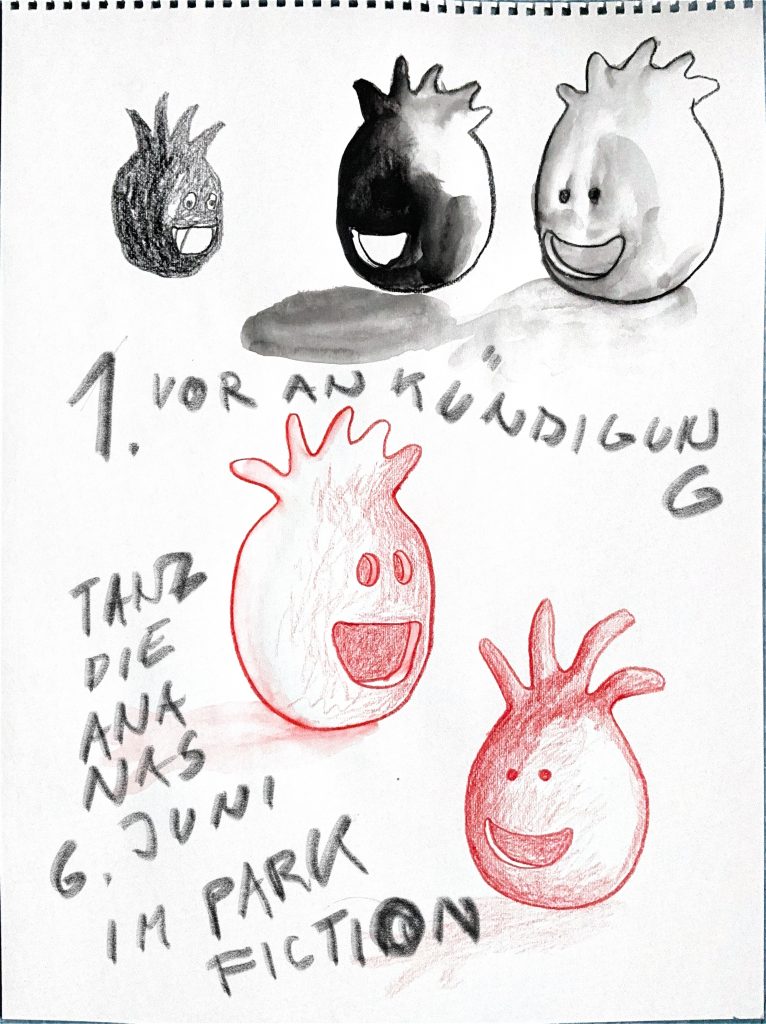
| 1.: Fest am 6. Juni 2026, 15 – 22 Uhr (oben und unten) 2.: Pläne gucken am 16. April, 17 – 20 Uhr (Kölibri) 3.: Ananas denken mit Eva von Redecker (hfbk) 4.: Schlechte Laune, Gute Laune. |
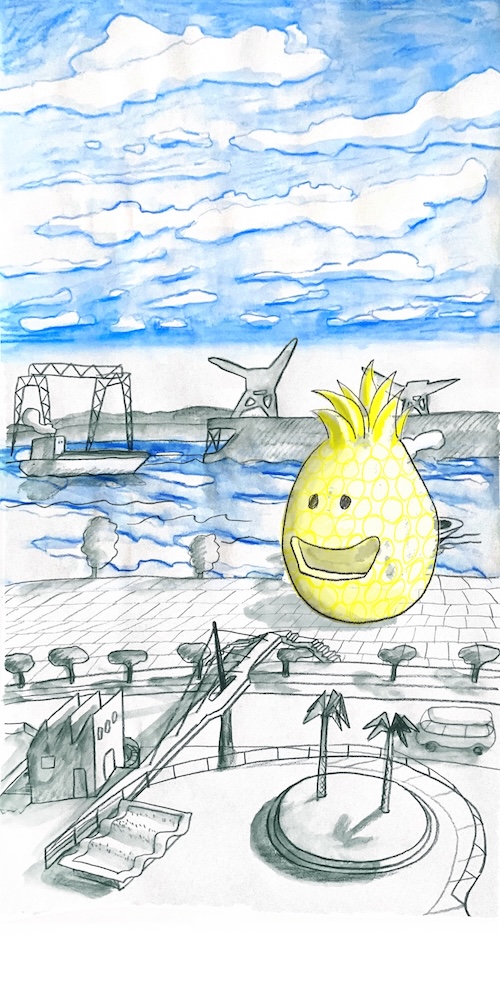
1.: Vorankündigung: Bitte haltet euch den 6. Juni frei – denn dann geht das erste Park Fiction Fest seit Jahren über die Bühne! Bespielt mit uns und vielen Freund:innen und Nachbar:innen den alten und den zukünftigen Park. Soviel schonmal vorab: Es wird kinderfreundlich, es wird spielerisch, es wird musikalisch, es wird viele, sehr kurze ästhetisch-politische Beiträge geben und zahlreiche Stationen um selbst aktiv zu werden!
„In Erwartung der Ananas“ – so ließen sich die Reaktionen auf den Gewinnerentwurf – für die Park-Fiction-Erweiterung ans Elbufer zusammenfassen. Für uns vom Park Fiction Komitee ist Rabe/Whites „Grünes Ding“ ein Grund zu feiern – denn der Entwurf platziert die Ideen aus der Wunschproduktion mit großer Entschlossenheit am Ufer.
Mit dem Fest probieren wir die zukünftige Verbindung von oben und unten spielerisch aus. Zugleich wollen wir den Original Park Fiction wieder stärker für Kinder und Jugendliche erschließen und für Kultur und Diskussion wiedergewinnen.
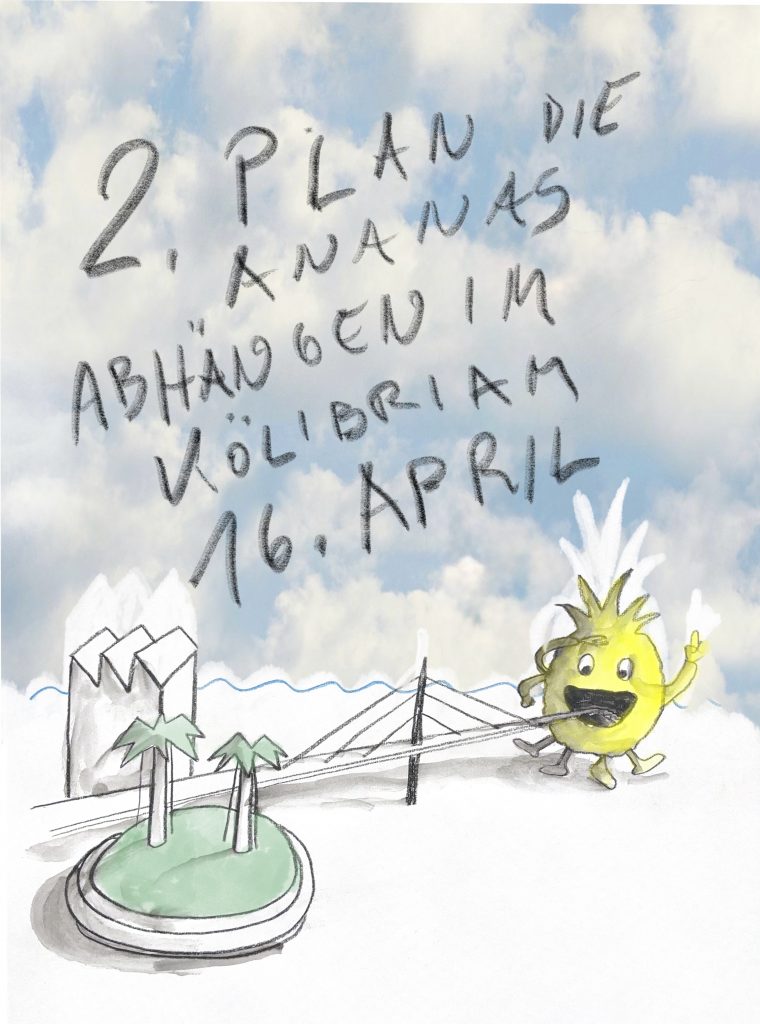
2.: Die Park-Erweiterungs-Pläne könnt ihr euch im Kölibri genauer anschauen: Am Donnerstag 16. April sind Rabe-White vor Ort, projektbüro und uvm haben für die BUKEA ein „produktives Abhängen“ organisiert. (Da die Ankündigung für Rückfragen und Irritation im Viertel sorgt: Wir vom Park Fiction Komitee werden da auch abhängen.)
3.: Internalisierte Austeritätspolitik: Wie zu erwarten, machen sich vereinzelte Einwände gegen die Neuplanung in verzichtsethischer Tradition am Ananas-Pavillon fest. Zufällig befasst sich Philosophin Eva von Redecker im druckfrischen Magazin der Hochschule für bildende Künste mit der Symbolik der Ananas in Kurt Weills Stück „Silbersee“ von 1933. In ihrem Text „Adynaton mit Ananas“ (S.53) steht die Ananas als Quelle des Glücks – und wird zugleich zum Agent des Versagens. Um den Gedankengang nachzuvollziehen, müsst ihr den ganzen Text lesen. Unverzichtbar aber dieser Ausschnitt, der viel mit Wunschproduktion zu tun hat, und, hier unausgesprochen, mit Ananas:
„Wenn man der Deutung der frühen Frankfurter Schule folgt, dann richtet sich der faschistische Kampf nicht nur gegen ein äußeres Feindbild. Faschistische Gewalt dient der Austreibung innerer Sehnsüchte, er gilt eigenen, unterdrückten Wünschen. Das ist ein schwieriger, aber überzeugender Gedanke. Emanzipatorische Positionen (…), bergen ein Versprechen, das man gar nicht nicht begehren kann. Freiheit, Gleichheit, Geschwisterlichkeit für alle. Und, wie man heute hinzufügen muss, die Bewahrung eines fragilen blauen Planeten.
Wenn diese Versprechen ihre Gegner kalt ließen, bräuchten sie sie gar nicht zu hassen. In der Dialektik der Aufklärung, haben Theodor W. Adorno und Max Horkheimer (…) diese Entwicklung in folgenden Sätzen nachgezeichnet:
»Es war der Sinn der Menschenrechte, Glück auch dort zu versprechen, wo keine Macht ist. Weil die betrogenen Massen ahnen, daß dies Versprechen, als allgemeines, Lüge bleibt, solange es Klassen gibt, erregt es ihre Wut; sie fühlen sich verhöhnt. Noch als Möglichkeit, als Idee müssen sie den Gedanken an jenes Glück immer aufs neue verdrängen, sie verleugnen ihn um so wilder, je mehr er an der Zeit ist. Wo immer er inmitten der prinzipiellen Versagung als verwirklicht erscheint, müssen sie die Unterdrückung wiederholen, die der eigenen Sehnsucht galt.«

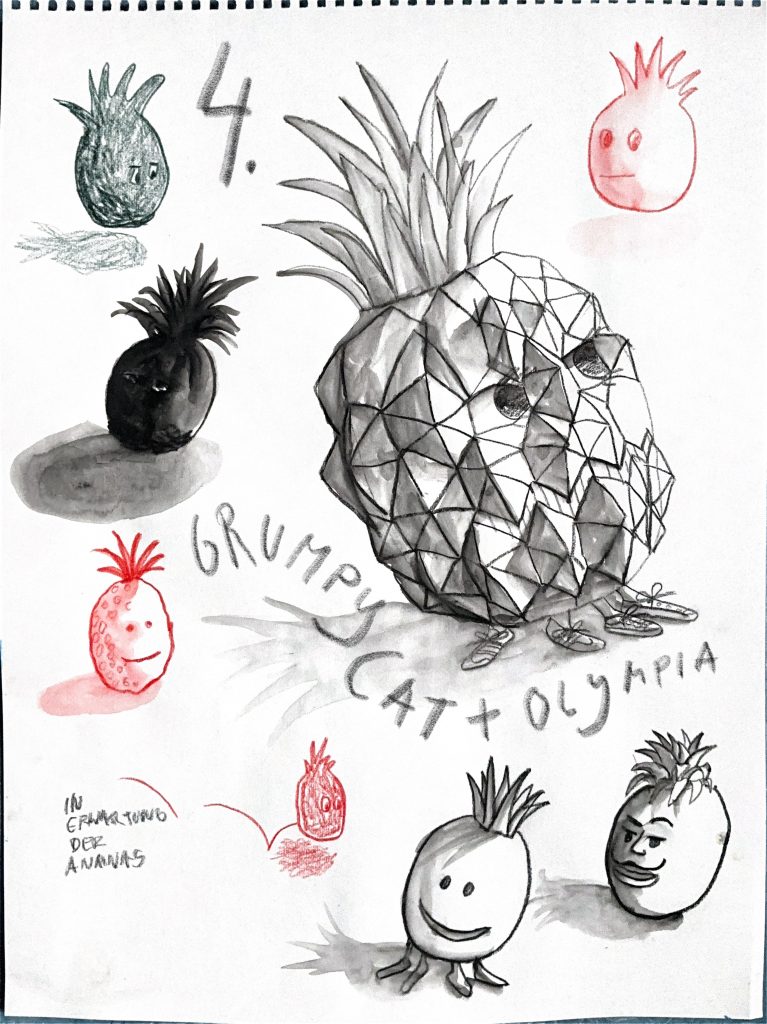
4.: Wer kennt das nicht: Ein Fest steht an, und irgendein Papa in Familie, Firma oder totalitärer Partei verlangt, dass alle jetzt gute Laune zu haben haben. Just das verlangte kürzlich 1 Innensenator, der in einer bizarren Rede den Gegner:innen seines Olympiavorhabens vorwarf, schlechte Laune zu verbreiten.
Dabei ist es doch so: Affirmation durch gute Laune brauchen Einfallslose als Bestätigung ihrer einfältigen Großmannspläne. Gute Ideen werden gar nicht so selten aus schlechter Laune geboren. Oder wie Anne Querrien einmal sagte:
„Jede Wunschproduktion beginnt mit einem Nein. „
Eure Grumpy Cat,
das Park Fiction Komitee
English Translation: Advance notice: DANCE THE PINEAPPLE From Park Fiction to Port Fiction 1.: Festival on the 6th June 2026, 3 – 10 pm (top and bottom) 2.: Look at plans on the 16th. April, 5 – 8 pm (Kölibri) 3.: Think the Pineapple with Eva von Redecker (hfbk) 4.: Bad Mood, Good Mood. 1.: Advance notice: Please save the date, June 6! Because then the first Park Fiction Fest in years goes on stage! Transform with us and many friends and neighbours the old and the future park. So much in advance: It will be child-friendly, it will be playful, it will be musical, there will be many, very short aesthetic-political contributions and numerous stations to become active yourself! „In anticipation of the pineapple“ – this is how the reactions to the winner’s draft could be summarised – for the park fiction expansion to the banks of the Elbe. For us at the Park Fiction Committee, Rabe/White’s „Green Thing“ is a reason to celebrate – because the design places the ideas from the desiring-production with great determination on the shore. With the festival we try out the future connection from above and below in a playful way. At the same time, we want to open up the Original Park Fiction more strongly for children and young people and win it back for culture and discussion. 2.: You can take a closer look at the park expansion plans in the Kölibri: On Thursday 16. Rabe-White are on site in April, projektbüro and uvm have organised a „productive hang-out“ for the BUKEA. (Since the announcement causes questions and irritation in the neighbourhood: We from the Park Fiction Committee will also hang out with you.) 3.: Internalised austerity policy: As expected, isolated objections to the new planning are voiced, and of course hailed at the Pineapple Pavilion. Coincidentally, philosopher Eva von Redecker deals with the symbolism of the pineapple in Kurt Weill’s play „Silbersee“ from 1933 in the freshly printed magazine of the HfbK. In her text „Adynaton mit Ananas“ (p.53), the pineapple stands as the source of happiness – and at the same time becomes the agent of failure. To understand the train of thought, you must read the entire text. Indispensable, however, is this excerpt, which has a lot to do with desiring-production, and, here unmentioned, with pineapple: „If one follows the interpretation of the early Frankfurt school, then the fascist struggle is not directed against an external enemy alone. Fascist violence serves to exorcise inner longings, it applies to one’s own, oppressed desires. This is a difficult but convincing thought. Emancipatory positions (…), hold a promise that cannot not be desired. Freedom, equality, fraternity for all. And, as one must add today, the preservation of a fragile blue planet. If these promises left their opponents cold, they wouldn’t need to hate them at all. In the Dialectics of the Enlightenment, Theodor W. Adorno and Max Horkheimer (…) traced this development in the following sentences: „It was the purpose of human rights to promise happiness even where there is no power. Because the deceived masses suspect that this promise, as a general thing, remains a lie as long as there are classes, it arouses their anger; they feel mocked. Still as a possibility, as an idea, they have to suppress the thought of that happiness again and again, they deny it all the more savager the more it is on time. Wherever it appears to be realised in the midst of the fundamental failure, they must repeat the oppression that applied to their own longing. 4.: Who doesn’t know this: A festivity is coming up, and some dad in family, company or totalitarian party demands that everyone is now in a good mood. This is what 1 Interior Senator recently demanded, who in a bizarre speech accused the opponents of his Olympic project of spreading a bad mood. Yet it is so: Affirmation through good humour is only needed by unimaginative people as confirmation of their simple-minded grand-man plans. Good ideas, in contrast, are often born out of a bad mood. Or as Anne Querrien once said: Every desiring-production starts with a no. Your Grumpy Cat, The Park Fiction Committee |